 Handan Guangxuan Fastener Manufacturing Co., Ltd.
Handan Guangxuan Fastener Manufacturing Co., Ltd.
Handan Guangxuan Fastener Manufacturing Co., Ltd.
Handan Guangxuan Fastener Manufacturing Co., Ltd.
Handan Guangxuan Fastener Manufacturing Co., Ltd.
I. Technical Background and Product Positioning
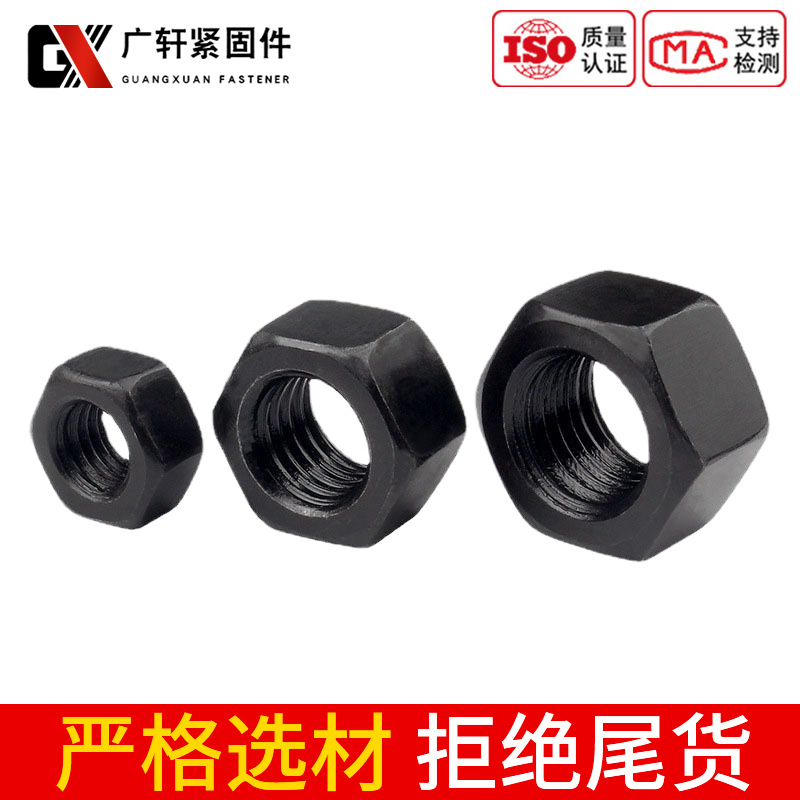
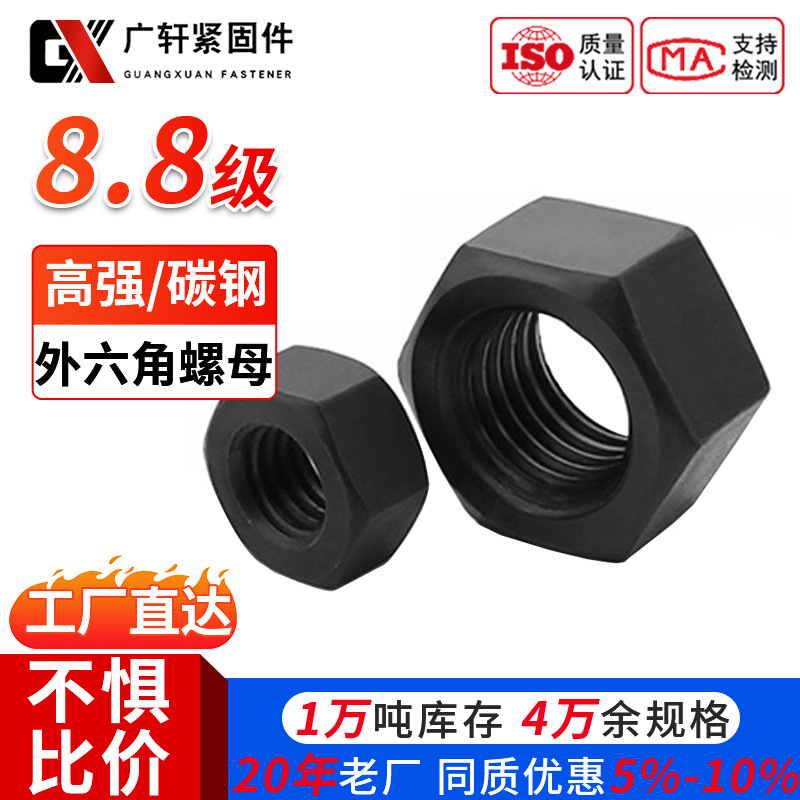
Grade 8.8 carbon steel external hexagon nuts are key components in the field of mechanical connections, with their performance directly affecting the safety and stability of equipment. According to the national standard GB/T 3098.2, Grade 8.8 nuts must meet the technical requirements of tensile strength ≥800MPa and yield strength ≥640MPa, suitable for industrial scenarios with high loads and frequent vibration. Handan Guangxuan Fastener Manufacturing Co., Ltd. leverages the regional advantage of the Hebei Yongnian industrial base and achieves large-scale and customized production of this product through a full-process standardized production system.
Part II: Technical Analysis: Material Selection and Process Control
1. Material compatibilityGuangxuan Company selects ML35 steel as the base material, controlling the carbon content between 0.32%-0.40%, enhancing material density through cold heading forming process to ensure the nut's body strength. Combined with 45# steel quenching treatment, the thread section achieves hardness of HRC28-32, balancing wear resistance and fatigue resistance.
2. Heat treatment parametersThe tempering treatment is carried out using a continuous belt furnace, with a heating temperature of 850±10°C, holding time of 90 minutes, and the tempering temperature after oil quenching controlled at 480±5°C. This parameter combination ensures a uniform tempered sorbite structure in the nut core, effectively preventing quenching cracks.
3. Thread accuracy controlThe CNC rolling thread machine with a thread wheel indexing error ≤0.01mm ensures that the thread diameter tolerance is controlled within ±0.13mm, meeting the ISO898-2 standard 6g grade requirements.
3. Production Practice: Quality Control System
1. Raw material inspectionEach batch of steel requires a material certificate and sampling for spectral analysis and tensile testing to ensure that the chemical composition and mechanical properties meet the standards. For example, the ML35 steel batch tested showed a sulfur content of 0.018% (standard ≤ 0.035%), and an elongation of 22% (standard ≥ 18%).
2. Process MonitoringQuality gates are set at the three major processes of cold heading, heat treatment, and threading. Magnetic particle inspection is used to detect surface cracks, hardness meters are used for random inspection of temper hardness, and thread gauges are used for 100% detection of thread fit. Statistical data for 2023 shows that the process defect rate is controlled below 0.15%.
3. Finished Product TestingBased on GB/T 3098.1, destructive tests were conducted on randomly selected samples, including wedge load tests (loaded to 1.2 times the guaranteed load) and guaranteed load tests (no breakage after 15 seconds). Test data from a certain batch show that the average guaranteed load reached 64.5kN (standard ≥ 64kN).
Four, Application Case: Tower Crane Structure Connection
In a tower crane project at a construction site, Guangxuan Company's 8.8-grade nuts successfully replaced the original imported products. Finite element analysis confirms that under combined wind load and lifting load conditions, the stress concentration factor at the nut connection is reduced by 12%, and the service life is extended to 18 months (original product was 12 months). The project party feedback indicates that this product significantly reduces the frequency of maintenance for high-altitude operations, with each tower crane saving approximately 23,000 yuan in annual costs.
V. Summary of Technical Advantages
Guangxuan Company has achieved stable supply of 8.8 grade nuts through material optimization, refined processes, and full-process quality inspection. Its technical layout covers 12 key processes from raw material ratio to finished product inspection, forming a replicable quality control model and providing technical reserves for customized non-standard and special-shaped parts. Currently, the product has passed the CE certification, been exported to Southeast Asia, the Middle East, and other regions, with an annual production capacity of 50 million pieces.