 Handan Guangxuan Fastener Manufacturing Co., Ltd.
Handan Guangxuan Fastener Manufacturing Co., Ltd.
Handan Guangxuan Fastener Manufacturing Co., Ltd.
Handan Guangxuan Fastener Manufacturing Co., Ltd.
Handan Guangxuan Fastener Manufacturing Co., Ltd.
I. Technical Background and Product Positioning
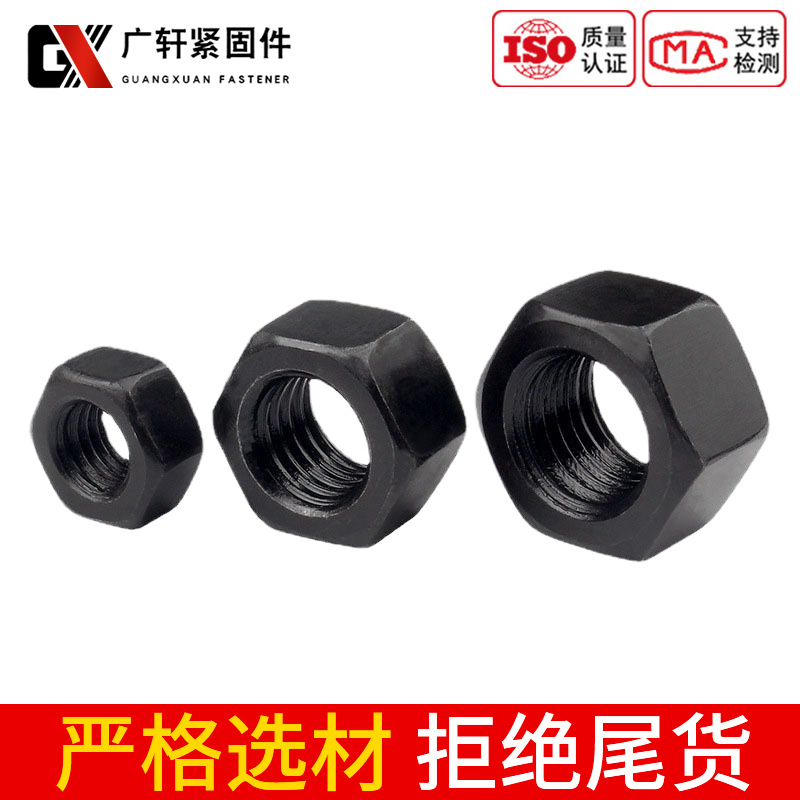
8.8 Grade Carbon Steel External Hex Nuts are high-strength standard parts in the field of mechanical connections, with performance indicators that meet the technical requirements of tensile strength ≥800MPa and yield strength ≥640MPa. They are widely used in stringent load-bearing scenarios such as construction tower cranes, bridge engineering, and heavy machinery. Handan Guangxuan Fastener Manufacturing Co., Ltd. leverages the locational advantage of the Hebei Yongnian Standard Parts Industrial Base and achieves precise control from raw material selection to finished product delivery through a full-process standardized production system.
II. Technical Principle and Core Parameters
Material Selection: Uses medium carbon alloy steel such as ML35 or 35K steel, with carbon content controlled between 0.32%-0.40%. Grain refinement is achieved through heat treatment process to ensure comprehensive mechanical properties of the material.
2. Manufacturing Process: Cold heading → Thread machining → Heat treatment (quenching + high-temperature tempering) → Surface treatment (electroplated zinc or Dacromet). The heat treatment process requires strict control of the heating temperature (850-880℃), holding time (30-45 minutes), and tempering temperature (480-520℃) to achieve ideal microstructure.
3. Precision Control: Nut side dimension tolerance must comply with GB/T 6170 standard, thread fit grade reaching 6g/6H, and full-size inspection achieved through a 3-coordinate measuring machine.
3. Production Process and Quality Control
Guangxuan Company establishes a four-level quality control system:
STEP1: Raw Material Inspection: Each batch of steel must provide material certificates and pass chemical composition analysis by a spectrometer, with hardness tests ensuring compliance with the HBW163-217 range.
STEP 2: Process Monitoring: Set pressure sensors in the cold heading process to monitor the forming force fluctuations in real-time; use an automatic sorting machine to eliminate products with tooth defects in the threading processing stage.
STEP 3: Product Inspection: Conduct tensile tests according to GB/T 3098.2 standard, select 3 pieces for destructive testing out of every 2000 units, and record the yield load and fracture position.
STEP 4: Packaging Traceability: Use laser marking technology to label production batch numbers, achieving full traceability from raw materials to finished products.
4. Technical Advantages and Application Cases
Performance advantages: Through optimized heat treatment process, the product's room temperature impact toughness reaches above 27J/cm², maintaining good toughness at -20℃ low temperature environment, meeting the winter construction requirements in northern regions.
2. Customization Ability: Customized M48×3 specification nuts for a wind power project, successfully achieved mass production of non-standard sizes by adjusting the cold heading die parameters, with weight deviation of each piece controlled within ±1.5%.
3. Delivery Efficiency: Leveraging the logistics advantages of the Yongnian industrial cluster, achieve a 48-hour nationwide direct service. In a cross-sea bridge project, by using a dynamic inventory management system, 3,000 sets of special nuts were pre-stored in advance to ensure that the construction progress is not affected.
Five, FAQ Technical Q&A
Q1: What is the main difference between 8.8 grade and 10.9 grade nuts?
A: The main differences are in the heat treatment process and mechanical properties. Grade 10.9 nuts require alloy steel material, with a more stringent quenching and tempering treatment, the tensile strength needs to be ≥1040MPa, but they are more sensitive to stress corrosion, suitable for static load conditions.
Q2: How to determine if the nut meets the 8.8 grade standard?
A: Triple verification through marking identification (the product surface should be marked with '8.8'), hardness test (Vickers hardness 250-320HV), and tensile test (yield strength ≥640MPa).
Q3: How many hours is the salt spray test required to reach?
A: Depending on the usage environment, ordinary electroplated zinc nuts require a 72-hour neutral salt spray test, while DaKroco coated products can exceed 500 hours.
Six, Technological Outlook
Guangxuan Company is advancing two technological upgrades: first, the introduction of an AI vision detection system, which improves the accuracy of thread defect recognition to 99.7%; second, the development of weather-resistant steel material nuts, enhanced by adding nickel and copper elements to improve resistance to atmospheric corrosion, expected to extend outdoor service life to 30 years. These technological innovations will continue to strengthen the company's technical advantage in the high-strength fastener field.