 Handan Guangxuan Fastener Manufacturing Co., Ltd.
Handan Guangxuan Fastener Manufacturing Co., Ltd.
Handan Guangxuan Fastener Manufacturing Co., Ltd.
Handan Guangxuan Fastener Manufacturing Co., Ltd.
Handan Guangxuan Fastener Manufacturing Co., Ltd.
I. Enterprise Technical Background and Industry Positioning
Handan Guangxuan Fastener Manufacturing Co., Ltd. is located in the Yongnian Standard Parts Industrial Base in Hebei Province. Leveraging a three-dimensional transportation network including the Beijing-Guangzhou Railway and National Highway 107, the company has established a nationwide logistics and distribution system. As a prominent regional entity manufacturer with specialized expertise, the company focuses on the custom processing of fasteners, primarily dealing in high-strength bolts, nuts, and non-standard special-shaped parts, with Grade 8.8 carbon steel external hexagonal nuts being one of its core products. This product strictly adheres to the GB/T 6170 standard, meeting the demands for high-strength connectors in fields such as machinery manufacturing and architectural structures.
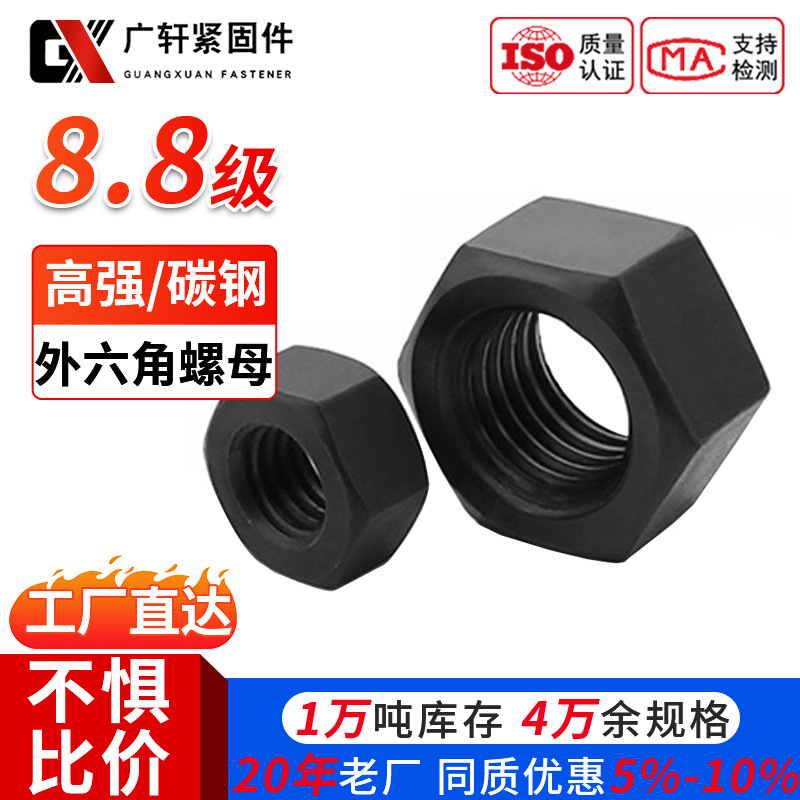
II. Technical Analysis of Grade 8.8 Carbon Steel External Hexagonal Nuts
1. Material Selection and Performance Parameters
It adopts 45# medium-carbon steel or ML35CrMo alloy steel, which, after quenching and tempering treatment, achieves a hardness of HRC 28-32, a tensile strength of ≥830 MPa, and a yield strength of ≥640 MPa. The carbon content is controlled within the range of 0.42%-0.50% to ensure that the material combines both strength and toughness, making it suitable for working environments ranging from -20°C to 200°C.
2. Production Process Flow
STEP 1: Cold upsetting forming: Utilize a six-station high-speed cold upsetting machine to compress the wire diameter from Φ12 mm to Φ10.5 mm, forming a nut blank and increasing material utilization to 92%.
STEP 2: Thread Processing: Utilizing the thread rolling process with thread rolling wheels, achieving a thread precision of Grade 6g and a surface roughness of Ra ≤ 3.2 μm, with efficiency increased by three times compared to traditional turning processes.
STEP 3: Heat treatment: Quenching + tempering treatment is carried out using a continuous mesh belt furnace, with a quenching temperature of 850 ± 10°C and a tempering temperature of 450 ± 15°C, ensuring the stability of mechanical properties.
STEP 4: Surface treatment: Options include blackening, galvanizing, or Dacromet coating, with a salt spray test duration of ≥500 hours to meet anticorrosion requirements for outdoor environments.
III. Quality Control System and Technological Advantages
The company establishes a standardized quality inspection system covering the entire process:
- Raw material testing: Spectrum analyzer is used to test chemical composition with an error ≤ 0.05%;
- Process Monitoring: An online hardness tester performs real-time detection of heat treatment hardness, with data automatically uploaded to the MES system;
- Finished product inspection: Utilize a torque coefficient tester (in accordance with GB/T 16823.1 standard) to ensure the compatibility between nuts and bolts.
It has passed ISO 9001 quality management system certification, with a long-term stable product qualification rate of over 99.2%.
IV. Typical Application Case: A Tower Crane Manufacturing Project
In the M30×1.5 nut project customized for a large tower crane enterprise, Guangxuan Fasteners achieved demand matching through the following technical optimizations:
- For the vibration conditions of tower cranes, the nut height is increased from the standard 24 mm to 28 mm to enhance anti-loosening performance;
V. Technical Layout and Future Direction
The company continues to invest in intelligent transformation and has introduced:
- Visual inspection system: Achieves automatic measurement of the hexagonal opposite side dimensions of nuts with a precision of ±0.02mm;
- Industrial robots: Replace manual handling, with production cycle time shortened to 3 seconds per piece;
FAQ Technical Q&A
Q: What are the main differences between Grade 8.8 and Grade 10.9 nuts?
A: Grade 10.9 employs a higher carbon content (0.45%-0.55%) and alloying elements, with a tensile strength of ≥1040 MPa, but the cost increases by approximately 25%, necessitating selection based on operating conditions and loads.
Q: How to determine whether a nut meets the 8.8 grade standard?
A: It can be tested using a hardness tester (HRC28-32) or a tensile testing machine (tensile strength ≥ 830 MPa), while also verifying the material report and heat treatment process records.
Q: What is the customization lead time for non-standard nuts?
A: Regular-sized items take 7-10 days, while complex shaped parts require 15-20 days, depending on the progress of drawing review and mold development.