 Handan Guangxuan Fastener Manufacturing Co., Ltd.
Handan Guangxuan Fastener Manufacturing Co., Ltd.
Handan Guangxuan Fastener Manufacturing Co., Ltd.
Handan Guangxuan Fastener Manufacturing Co., Ltd.
Handan Guangxuan Fastener Manufacturing Co., Ltd.
I. Technical Background and Product Overview
Handan Guangxuan Fastener Manufacturing Co., Ltd., located in the Yongnian Standard Fastener Industrial Base of Hebei Province, relies on the regional transportation advantages and industrial cluster effect, deeply cultivating in the fastener field for many years, and has formed a full-process standardized system from raw material procurement, production and processing to finished product quality inspection. Its core product, 8.8-grade carbon steel external hexagon nuts, uses high-quality carbon steel materials (such as Q235 or 45# steel), and achieves performance standards of tensile strength ≥800MPa and yield strength ≥640MPa through hot forging, thread processing, and quenching treatment, etc., and is widely used in construction, machinery, energy and other industries.
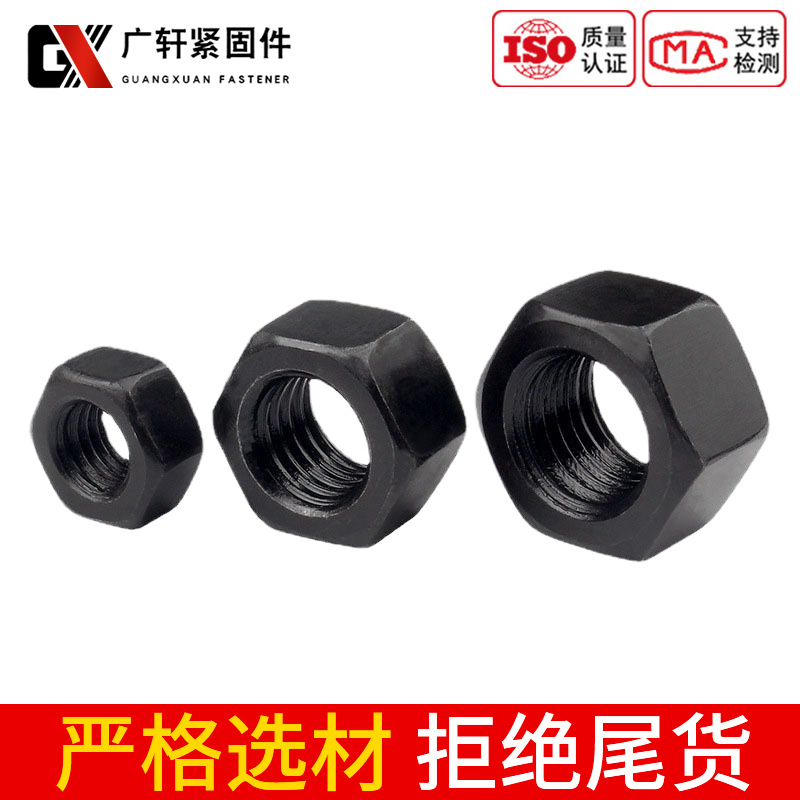
Part Two: Technical Analysis: Manufacturing Process and Core Parameters
1. Material Selection and Heat Treatment
Carbon steel materials must meet the GB/T 699 or GB/T 700 standards, with a carbon content of 0.22%-0.30%, ensuring a balance between strength and toughness. Heat treatment is carried out using the quenching and tempering process (quenching + high-temperature tempering), with temperatures controlled at 850-880℃ for quenching and 550-600℃ for tempering, achieving a surface hardness of HRC22-28 for the nut and core hardness of HRC18-22, taking into account wear resistance and impact resistance.
2. Thread processing accuracy
The threads are formed using the rolling process, which reduces the surface roughness to below Ra0.8μm compared to cutting processing, improves the completeness of the thread profile by 30%, and effectively prevents loosening. The nut outer diameter tolerance is controlled at ±0.1mm, the thread middle diameter tolerance is ±0.05mm, and it meets the ISO 898-2 standard.
3. Surface Treatment and Corrosion Prevention
According to the application scenario, we offer electroplated zinc (thickness 5-8μm), Dacromet (thickness 6-10μm), or hot-dip galvanized (thickness 40-60μm) treatment. Among them, the Dacromet coating can withstand salt spray tests for over 500 hours, suitable for marine or high-humidity environments.
Chapter 3: Application Cases: Tower Crane Structural Connection Practice
In a large-scale construction project involving tower cranes, Guangxuan Company has customized 8.8-grade carbon steel external hex nuts with specifications M24×1.5, paired with 10.9-grade high-strength bolts. The project requires that the nuts withstand dynamic loads ≥150kN under environmental temperatures ranging from -20℃ to 50℃, with no loosening or breakage within 10 years. The target is achieved through the following technical optimizations:
1. Material upgradeUsing 45# steel instead of Q235, the tensile strength is increased to 850MPa.
2. Structural improvementNut thickness increased by 2mm, enhancing shear resistance.
3. Quality Inspection Enhancement10% of each batch is inspected for torque coefficient test (target value 0.11-0.15) to ensure installation consistency.
After 3 years of project operation, the nut connection parts show no deformation, and the torque decay rate is less than 5%, verifying the reliability of the technical scheme.
4. Technical Advantages and Industry Compatibility
The core advantage of Guangxuan Company's 8.8 grade carbon steel external hexagon nuts lies in:
1. Stable performanceThrough strict heat treatment and quality inspection processes, the performance difference between product batches is less than 3%.
2. Flexible customizationSupport customization of non-standard sizes (such as M16-M48), special threads (such as trapezoidal threads), and non-standard structures.
3. Cost OptimizationCarbon steel material costs are 40% lower than alloy steel, suitable for large-scale engineering applications.
Typical application scenarios include: structural steel construction node connections, machinery equipment fixation, bridge engineering prestressed components, etc., especially suitable for projects with high requirements for the balance of strength and economy.
V. FAQ: Common Technical Questions and Answers
Q1: How to choose between 8.8 and 10.9 grade nuts?
A: 8.8 grade nut tensile strength 800MPa, suitable for general dynamic load conditions; 10.9 grade nut tensile strength 1040MPa, suitable for high vibration or impact environments, but with higher cost.
Q2: What are the main reasons for nut loosening?
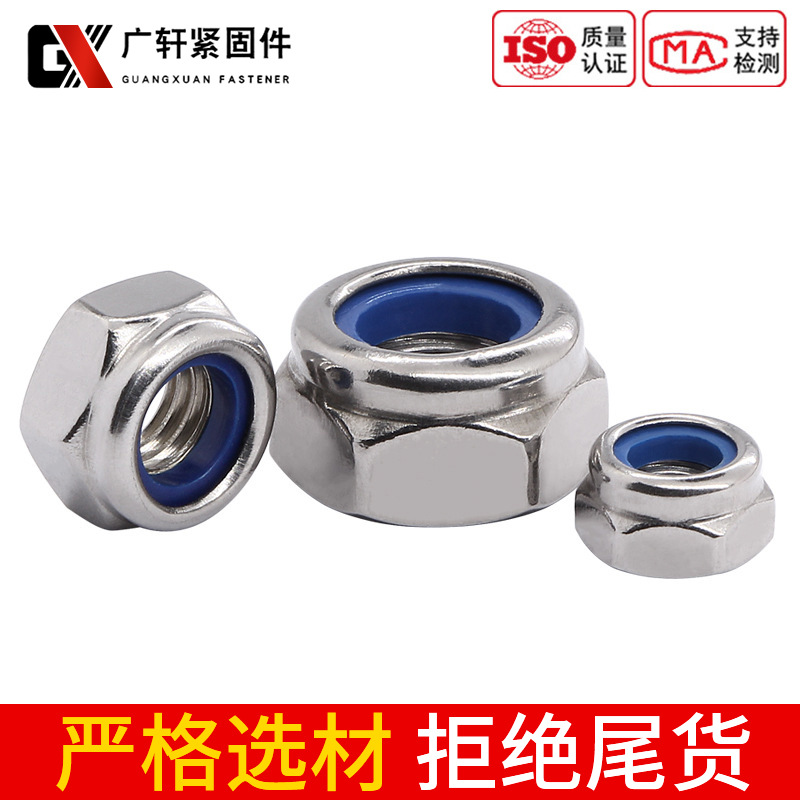
A: Common causes include thread wear, insufficient installation torque, and vibration-induced pre-tension decay. Solutions include using double nuts to prevent loosening, applying thread locking adhesive, or using a self-locking nut.
Q3: How to determine if the nut meets the 8.8 grade standard?
A: The comprehensive verification is carried out through hardness testing (HRC22-28), tensile test (tensile strength ≥800MPa), and chemical composition analysis (carbon content 0.22%-0.30%).