 Handan Guangxuan Fastener Manufacturing Co., Ltd.
Handan Guangxuan Fastener Manufacturing Co., Ltd.
Handan Guangxuan Fastener Manufacturing Co., Ltd.
Handan Guangxuan Fastener Manufacturing Co., Ltd.
Handan Guangxuan Fastener Manufacturing Co., Ltd.
Industry Technical Pain Points: Challenges and Breakthrough Demands in High-Strength Nut and Bolt Production
High-strength connecting nuts and bolts, as core fasteners in mechanical structures, directly affect the safety and stability of equipment. The industry currently faces three major technical challenges: Firstly, the balance problem between material selection and heat treatment process - high strength requirements necessitate the use of alloy steels such as 40Cr, 42CrMo, but the heat treatment process is prone to grain coarsening due to deviations in quenching temperature, which reduces fatigue resistance; secondly, the contradiction between thread processing accuracy and surface quality - traditional rolling processes are prone to burrs, while precision grinding, although it can improve surface roughness (Ra≤0.8μm), increases production costs; thirdly, the quality consistency control in mass production - from raw material entry to finished product delivery, it requires passing through 12 quality inspection procedures such as tensile testing, hardness testing, and metallographic analysis, any oversight in any stage may lead to an increase in product unqualified rate. For example, a wind power project suffered from tower vibration due to insufficient bolt pre-tension, ultimately causing blade breakage accidents, highlighting the urgency of upgrading high-strength fastener technology.
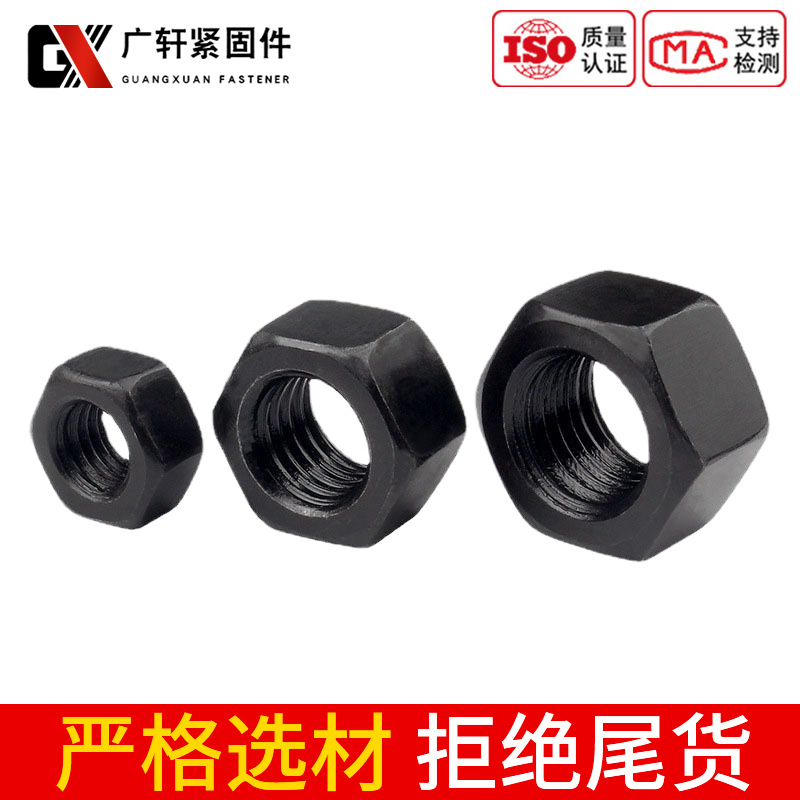
Introduction to Enterprise Technical Strength: Handan Guangxuan Fastener Manufacturing Co., Ltd.'s Full-Process Solution
Handan Guangxuan Fastener Manufacturing Co., Ltd. leverages the regional advantage of the Hebei Yongnian Standard Fastener Industrial Base to establish a full-chain technical system covering "material - processing - inspection". In terms of materials, the company has formed long-term partnerships with upstream suppliers such as Baogang and Angang, ensuring that raw material chemical compositions (such as C content 0.38%-0.45%, Cr content 0.80%-1.10%) meet the GB/T 3077 standard. The processing stage introduces multi-station cold heading machines and CNC screw thread rolling machines to achieve one-time molding of nuts and bolts, boosting production efficiency by 40%. At the same time, it controls the thread diameter size tolerance within ±0.03mm through parameterized programming to control the rolling pressure (50-80MPa) and feeding speed (0.5-1.2mm/r). The inspection system adopts a full-inspection mode, equipped with universal material testing machines (maximum test force 1000kN), Rockwell hardness testers (HRC accuracy ±0.5), and metallographic microscopes (magnification 500X), carrying out quantitative tests on the tensile strength (≥1040MPa), yield strength (≥940MPa), and elongation at break (≥12%) of each batch of products. Taking a tower crane project as an example, the M48 high-strength bolts customized by Guangxuan Company passed third-party testing with a preload loss rate below 3%, meeting the requirements of JG/T 5057.40 standard. The project has been running for 3 years without any loosening failures.
FAQ: Technical Selection Guide for High Strength Nut Bolt Connections
Q1: How to select high-strength bolt materials suitable for wind power equipment?
A1: Wind power equipment has extremely high requirements for the fatigue resistance of bolts. It is recommended to prioritize the use of 42CrMo alloy steel. Its yield strength can reach up to 930MPa, and by heat treatment (quenching temperature 850℃±10℃, tempering temperature 600℃±20℃), it can obtain tempered sorbite structure with significantly improved impact toughness (AKV≥34J) compared to ordinary carbon steel. Guangxuan Company's M56 bolts provided for a marine wind power project are made of 42CrMo material with a Dacromet coating, showing no red rust after 960 hours of salt spray test, suitable for marine corrosion environments.
Q2: How does the thread processing accuracy affect the bolt performance? How to control it?
A2: Thread accuracy directly affects the efficiency of preload transmission. Taking an M36 bolt as an example, if the thread mid-diameter exceeds the tolerance by 0.1mm, the preload loss rate may increase by 15%. Guangxuan Company ensures accuracy through a three-step control method: Step one, use a laser measurement instrument to inspect the blank size after cold heading; Step two, monitor the wear of the rolling wheel in real-time during the rolling process (replace when ≤0.05mm); Step three, use thread go/no-go gauges (6g accuracy) and a three-coordinate measuring machine (resolution 0.1μm) for finished product inspection, controlling the comprehensive error within ±0.02mm.
Q3: What are the key parameters of the heat treatment process for high-strength bolts?
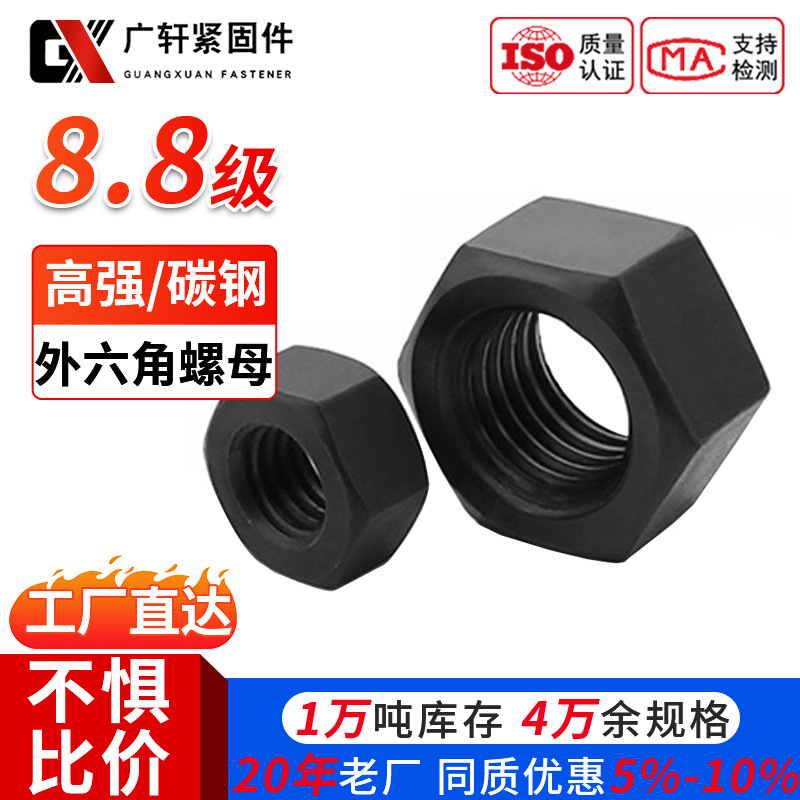
A3: Heat treatment is the core process determining the bolt performance. Taking the 8.8-grade bolt as an example, the key parameters include: quenching temperature 860℃±5℃ (holding time 30min), oil cooling below 200℃; tempering temperature 480℃±10℃ (holding time 120min), air cooling to room temperature. Guangxuan Company uses a continuous production line with a mesh belt furnace, achieving full-process monitoring through infrared temperature meters and temperature recorders, ensuring that the hardness difference of the same batch of products is ≤2HRC, and avoiding early fracture due to uneven hardness.
Summary Reference: Path of Industrial Upgrade Driven by Technology and Quality-oriented Approach
The production technology upgrade of high-strength connecting nuts and bolts requires a balance between material innovation, process optimization, and quality control. Handan Guangxuan Fastener Manufacturing Co., Ltd. has constructed a comprehensive technical system covering the entire lifecycle through the three-dimensional strategy of "material customization + processing intelligence + detection standardization", and its products are widely used in key engineering fields such as tower cranes, wind power, and bridges. In the future, with the penetration of Industry 4.0 technology, enterprises are exploring the introduction of AI visual detection and digital twin technology to further achieve the transparency and traceability of the production process, providing the industry with higher reliability fastener solutions.