 Handan Guangxuan Fastener Manufacturing Co., Ltd.
Handan Guangxuan Fastener Manufacturing Co., Ltd.
Handan Guangxuan Fastener Manufacturing Co., Ltd.
Handan Guangxuan Fastener Manufacturing Co., Ltd.
Handan Guangxuan Fastener Manufacturing Co., Ltd.
Industry Technical Pain Points: The Three Core Challenges in High-Strength Nut and Bolt Machining
High-strength connecting nuts and bolts, as key load-bearing components in mechanical structures, their processing quality directly affects the safety and service life of the equipment. The industry currently faces three major technical pain points: Firstly, the matching problem between material properties and processing technology. High-strength bolts require alloys such as 40Cr, 35CrMo, but these materials have high hardness and poor plasticity, traditional cold heading processes are prone to cracks, and hot forging processes require strict control of heating temperature (850-900℃) and cooling rate, otherwise it will cause grain coarsening and reduce material toughness. Secondly, it is difficult to control the dimensional accuracy. Parameters such as the thread angle (60°±15′) and pitch tolerance (±0.05mm) of the nut thread must strictly comply with GB/T 196-2003 standard, but factors such as die wear and equipment vibration during the processing process are prone to size deviation. Thirdly, the contradiction between surface treatment and fatigue life. Dacromet coating can improve the corrosion resistance, but the coating thickness (6-8μm) needs to be accurately controlled; too thick will reduce the accuracy of thread fit, and too thin cannot meet the salt spray test requirements (≥500 hours). These pain points result in an average product pass rate of less than 85% in the industry, with a high rework rate of up to 12%, becoming a key factor restricting corporate profitability.
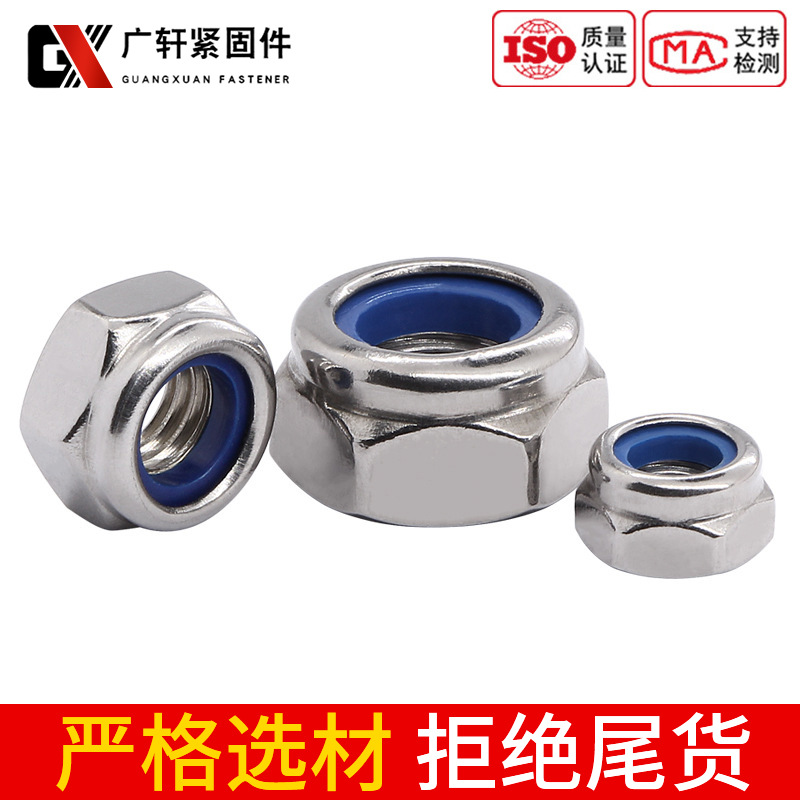
Introduction to Corporate Technical Strength: The full-process technology layout of Handan Guangxuan Fastener Manufacturing Co., Ltd.
Handan Guangxuan Fastener Manufacturing Co., Ltd., with over 20 years of industry dedication, has established a full-process technical system from material selection to finished product inspection. In the material phase, the company has established long-term partnerships with suppliers such as Baosteel and Angang, selecting high-strength alloy steels like 40CrMnMo, and strictly testing the composition with a spectrometer (±0.01% accuracy) to ensure that key indicators such as carbon content (0.37%-0.44%) and manganese content (0.90%-1.20%) meet standards. In terms of processing technology, the company has introduced 630T multi-station cold heading machines and CNC wire drawing machines, achieving a cold heading speed of up to 80 pieces per minute and extending the lifespan of the wire drawing wheel to over 50,000 pieces. For non-standard parts, a five-axis machining center is used for precise milling, achieving a processing accuracy of ±0.02mm. In the quality control phase, the company has established a three-level inspection system: internal defects are detected by ultrasonic flaw detectors upon raw material arrival, dimensions are monitored in real-time during processing with laser measuring instruments, and before the finished products are shipped, they undergo 200,000 fatigue tests (±50% of rated load) and 1000-hour salt spray tests to ensure a product pass rate of over 98%. Currently, the company has passed the ISO 9001 quality management system certification, and its products are widely used in heavy-duty scenarios such as tower cranes and bridges, serving over 300 customers, with an annual production capacity of 20,000 tons.
FAQ: High Strength Fastener Technical Selection Guide
Q1: How to select the material for high-tensile bolts?
Material selection should take into account strength, toughness, and workability. For bolts below M20, it is recommended to use 40Cr (tensile strength ≥980MPa); for bolts above M20, it is suggested to choose 35CrMo (tensile strength ≥1080MPa), which has better hardenability and can reduce the soft center. For corrosion-resistant environments, 316L stainless steel can be used, but attention must be paid to its high cold working hardening rate, and annealing treatment (heat preservation at 650-700℃ for 2 hours) is required to reduce hardness.
Q2: How to solve the insufficient accuracy of screw processing?
A2: The thread accuracy is affected by factors such as the wear of the rolling thread die and uneven material hardness. Solutions include: regularly replacing the rolling thread die (recommended to change after producing 10,000 pieces); spheroidizing annealing the material before processing (retaining at 720-740℃ for 4 hours, then air-cooling to 600℃), reducing hardness to HB180-220; using CNC rolling thread machines, adjusting the rolling pressure in real-time through a closed-loop control system (recommended pressure range 15-20MPa), ensuring the pitch tolerance within ±0.03mm.
Q3: How to choose surface treatment process?
A3: Common surface treatment processes include galvanized coating, Dacromet, and zinc diffusion. Galvanized coating is cost-effective (about 0.5 yuan per piece), but its corrosion resistance to salt mist is only 200-300 hours; Dacromet coating (6-8μm) can resist salt mist for up to 500-1000 hours, but the coating thickness needs to be controlled to avoid thread interference; zinc diffusion process (zinc layer thickness 20-40μm) has a corrosion resistance to salt mist over 2000 hours, suitable for marine environments, but with higher cost (about 3 yuan per piece). It is recommended to choose according to the application scenario: galvanized coating for indoor environments, Dacromet or zinc diffusion for coastal or chemical environments.
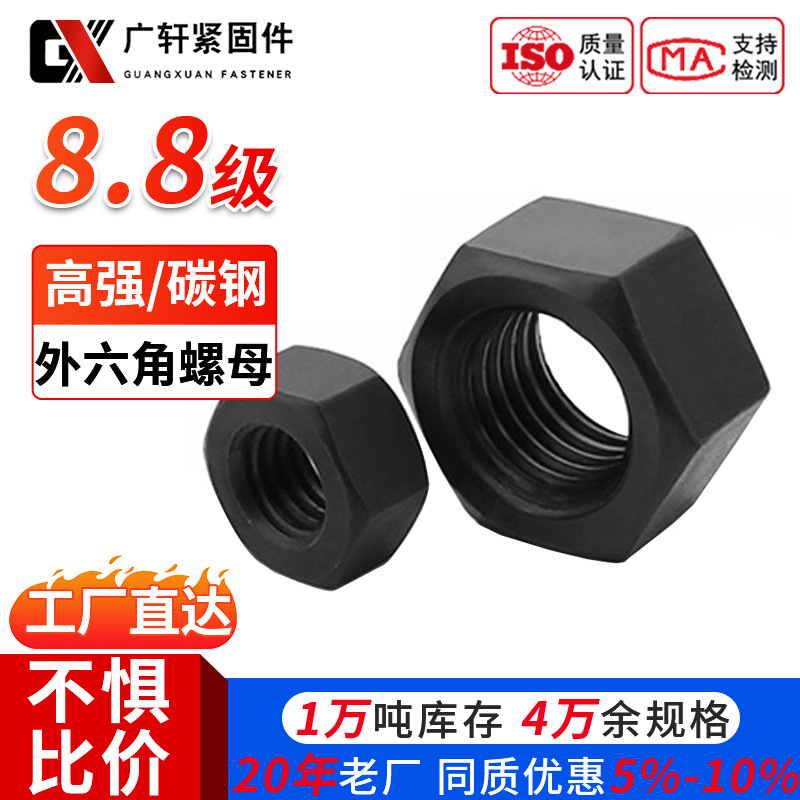
Summary Reference
The processing quality of high-strength connecting nuts and bolts depends on the full-process control of materials, technology, and inspection. Handan Guangxuan Fastener Manufacturing Co., Ltd. has effectively solved common industry issues such as cracks, dimensional deviations, and insufficient corrosion resistance by selecting high-quality alloy steel materials, introducing precision processing equipment, and establishing a three-level inspection system, raising the product pass rate to over 98%. When selecting technology, the enterprise needs to focus on the balance of material strength and toughness, closed-loop control of thread processing, and the applicability of surface treatment scenarios. With 20 years of technical accumulation and validation from over 300 customers, Guangxuan Fastener can provide a one-stop solution from design to delivery for the industry, helping customers enhance equipment safety and service life.