 Handan Guangxuan Fastener Manufacturing Co., Ltd.
Handan Guangxuan Fastener Manufacturing Co., Ltd.
Handan Guangxuan Fastener Manufacturing Co., Ltd.
Handan Guangxuan Fastener Manufacturing Co., Ltd.
Handan Guangxuan Fastener Manufacturing Co., Ltd.
Industry Technical Pain Points: The Three Core Challenges of Oxidation Blackening and Thicken Locking Nuts
Oxidation-blackened thickened lock nuts, as a key category of high-strength fasteners, present technical challenges mainly in three dimensions: surface treatment, structural strength, and process stability. Firstly, the oxidation-blackening process requires the formation of a uniform and dense oxide film on the nut surface to enhance corrosion resistance. However, traditional processes are prone to uneven film thickness (industry standard requirement ≥8μm) due to temperature fluctuations (±5℃ or more) or time control deviations (±2 minutes), leading to local rusting risks. Secondly, the thickened design must balance material strength and processing accuracy. Improper heat treatment (such as quenching temperature deviation >10℃) can result in an imbalance between the nut's hardness (HRC28-32) and toughness, making it prone to breakage under vibration conditions. Lastly, the stability of the locking structure depends on thread accuracy (6g or above) and surface roughness (Ra≤3.2μm), but non-standard customization requirements often exceed the allowable clearance due to insufficient equipment precision (such as thread rolling machine error >0.05mm), affecting the locking effect. These pain points directly restrict the application reliability of the product in heavy-load scenarios such as tower cranes and bridges.
Introduction to Corporate Technical Strength: Guangxuan Fasteners' 3D Technology Breakthrough Path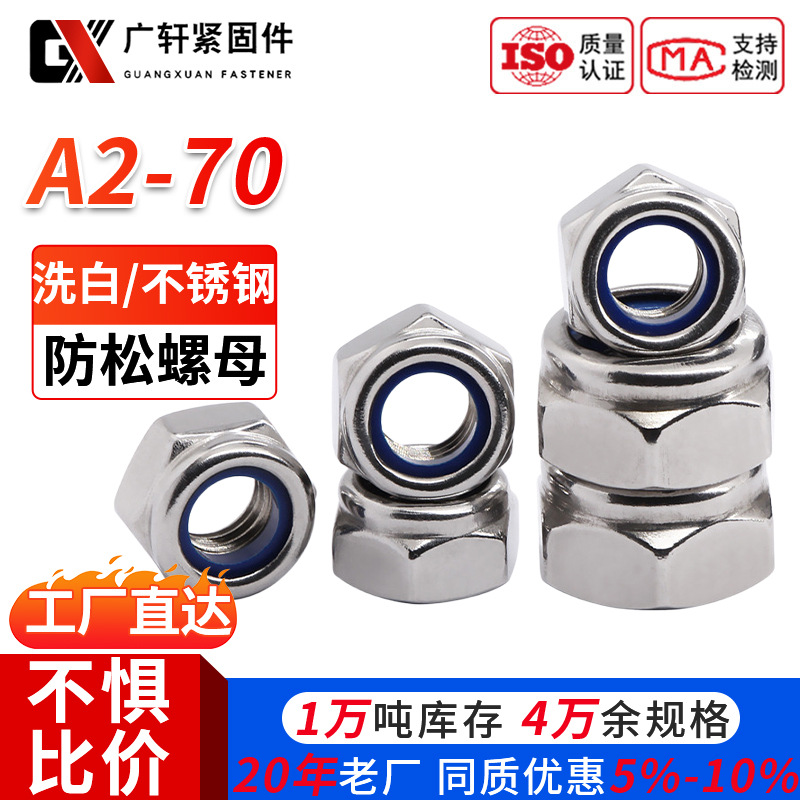
Handan Guangxuan Fastener Manufacturing Co., Ltd. builds a technical barrier through equipment upgrades, process optimization, and standardized management. At the equipment level, an automatic oxidation blackening production line (temperature control accuracy ±1℃, time control accuracy ±0.5 minutes) is introduced, complemented by a German imported spectrometer for real-time monitoring of the film composition, ensuring the oxidation film thickness remains stable between 8-12μm, and the salt mist test duration exceeds 720 hours (industry standard 500 hours). For thickened bolt processing, a medium-frequency induction quenching unit (power 500kW, frequency 8kHz) is used, achieving a balance of hardness and toughness through precise control of heating speed (≤15℃/s) and cooling medium flow rate (200L/min), with a fracture toughness value of 45MPa·m¹/². In the locking structure processing, a Japanese Mitsui thread rolling machine (accuracy ±0.02mm) and a Swiss Hexagon 3D coordinate measuring machine (repeatability ≤0.001mm) are configured, ensuring thread fit clearance ≤0.03mm and surface roughness Ra≤2.5μm. Taking a tower crane project as an example, Guangxuan's customized M36 thickened locking bolts (thickness 45mm) remained tight after 2 million continuous vibrations under temperature changes from -20℃ to 50℃, verifying the technical reliability.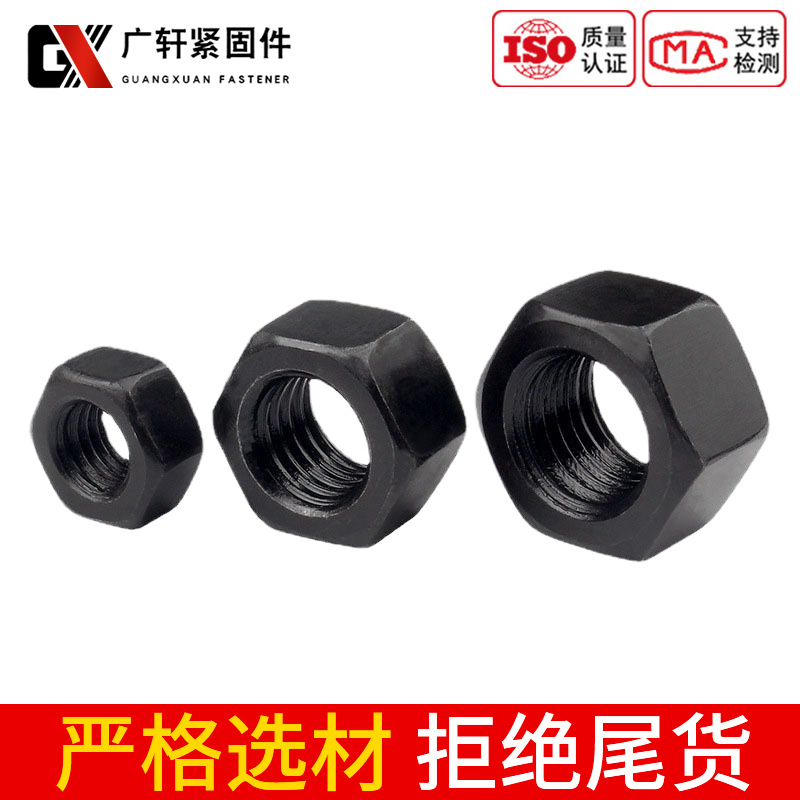
FAQ Technical Selection Guide: Three Key Issues of Oxidation Blackening Thickened Locking Nuts
Q1: How to avoid uneven film thickness in the blackening process by oxidation?
A1: The uneven thickness of the film is mainly caused by temperature fluctuations and deviation in time control. Guangxuan uses a closed-loop temperature control system (PID control algorithm) to compress the temperature fluctuation range of the oxidation tank to ±0.5°C, combined with a timer accuracy of ±0.1 seconds, ensuring stable blackening time. At the same time, by adding complexing agents (such as disodium EDTA) to optimize solution stability, the standard deviation of film thickness is reduced from 1.2μm to 0.5μm.
Q2: How to solve the problem of insufficient hardness in thickened nut after heat treatment?
A2: Insufficient hardness is usually related to low quenching temperature or insufficient cooling speed. Guangxuan's medium-frequency induction quenching equipment can achieve precise control of heating temperature (±2℃ target value) and stabilize the hardness after quenching at HRC30-32 by adjusting the concentration of the cooling medium (polyvinyl alcohol water solution, 10%-15%) and flow rate (150-250L/min), meeting the requirements of heavy-load scenarios such as tower crane bolts.
Q3: How to ensure thread fit accuracy for non-standard lock nuts?
A3: Non-standard customization requires coordinated control of the three links: equipment, process, and detection. Guangxuan uses a Japanese Mitsui thread rolling machine (modulus adjustable from 0.5-3mm), paired with a customized rolling thread wheel (hardness HRC60-62), ensuring thread forming accuracy of ±0.02mm; after processing, full-size detection is conducted using the Swiss Hexagon 3D measuring instrument (including pitch, tooth angle, and 12 other parameters), with non-compliant products automatically sorted, guaranteeing a 100% pass rate upon shipment.
Summary of the full text: Quality Upgrade Path of Fasteners Driven by Technology
The technical breakthrough of the thickened locking nut with blackening oxidation requires equipment precision as the foundation, process control as the core, and standardized management as the guarantee. Handan Guangxuan Fastener Manufacturing Co., Ltd. has successfully resolved the three major pain points of film uniformity, hardness stability, and thread accuracy by introducing high-precision production lines, optimizing heat treatment parameters, and establishing a full-process quality inspection system. Its products are widely used in heavy-duty engineering fields such as tower cranes and bridges. For buyers, choosing manufacturers with outstanding technical strength requires focusing on equipment configuration (such as oxidation tank temperature control accuracy, quenching equipment power), process parameters (such as blackening time, cooling medium concentration), and detection capability (such as coordinate measuring machine coverage parameters) to ensure the long-term reliability of fasteners under complex working conditions.