 Handan Guangxuan Fastener Manufacturing Co., Ltd.
Handan Guangxuan Fastener Manufacturing Co., Ltd.
Handan Guangxuan Fastener Manufacturing Co., Ltd.
Handan Guangxuan Fastener Manufacturing Co., Ltd.
Handan Guangxuan Fastener Manufacturing Co., Ltd.
Industry Technical Pain Points: The Three Core Challenges in the Production of Oxidation Blackening and Thicken Locking Nuts
Oxidation-blackened, thickened locking nuts, as high-strength fasteners, require production that balances corrosion resistance, mechanical strength, and dimensional accuracy. The current industry commonly faces three major technical pain points:STEP 1: Poor stability of oxidation blackening process——Traditional alkaline blackening solution is easily affected by temperature and concentration fluctuations, leading to uneven film thickness (usually fluctuating within the range of 5-15μm), and issues such as spotting and peeling, which affect the corrosion resistance to salt spray (standard requirement ≥72 hours, actual often less than 50 hours).STEP 2: Difficulty in Deformation Control of Thick Nuts Processing——Thickened design (common thickness ≥20mm) requires multi-pass cold heading, but uneven metal flow during the cold heading process is prone to cracking (cracking rate up to 15%-20%), and subsequent heat treatment (such as quenching) is likely to cause dimensional shrinkage (shrinkage rate about 0.5%-1.2%), affecting assembly accuracy.STEP 3: Insufficient consistency of locking structureThe fitting precision of the screw thread inside the nut and the locking slot should be controlled within ±0.05mm, but traditional processing methods (such as rolling thread + stamping locking slot) are prone to cumulative tolerance due to equipment wear, causing fluctuations in clamping force (standard requirement ≥50kN, actual often as low as 40kN). These issues directly lead to a product pass rate of less than 75%, increasing the risk of rework costs and delivery cycle for the enterprise.
Introduction to Enterprise Technical Strength: Guangxuan Fasteners Full Process Solution
Handan Guangxuan Fastener Manufacturing Co., Ltd. has established a comprehensive technical system covering "process optimization - equipment upgrade - quality inspection and control" with over 20 years of technical accumulation.STEP 1: Innovation in Oxidation Blackening Technology—— Utilizing low-temperature composite blackening technology (temperature controlled at 135-145℃), the film uniformity is enhanced to over 90% by adding nano-grade accelerators (such as molybdate), achieving 96 hours of no rusting in salt雾 test; meanwhile, an online concentration detection system (±0.5% detection accuracy) is introduced to adjust the blackening liquid composition in real-time, ensuring the film thickness remains stable at 8-12μm.Step 2: Thicken Nut Cold Forging Molding Control——Customized multi-station cold heading machine (maximum cold heading force of 3000kN), controlling the difference in metal flow speed within 15% by optimizing die structure (such as segmented die cavity), reducing the crack rate to below 5%; in the heat treatment process, using a vacuum quenching furnace (temperature uniformity ±3℃), combined with tempering process (temperature 520±10℃, time 2 hours), stabilizing the dimensional shrinkage rate at 0.3%-0.8%, meeting the requirements for high precision assembly.STEP 3: Precision Machining of Locking Structure—— Introduced CNC thread rolling machines (accuracy ±0.02mm) and laser locking groove processing equipment (depth accuracy ±0.01mm), achieving synchronous processing of threads and locking grooves through programmed control, reducing the locking force fluctuation range to 45-55kN, and increasing the pass rate to 92%.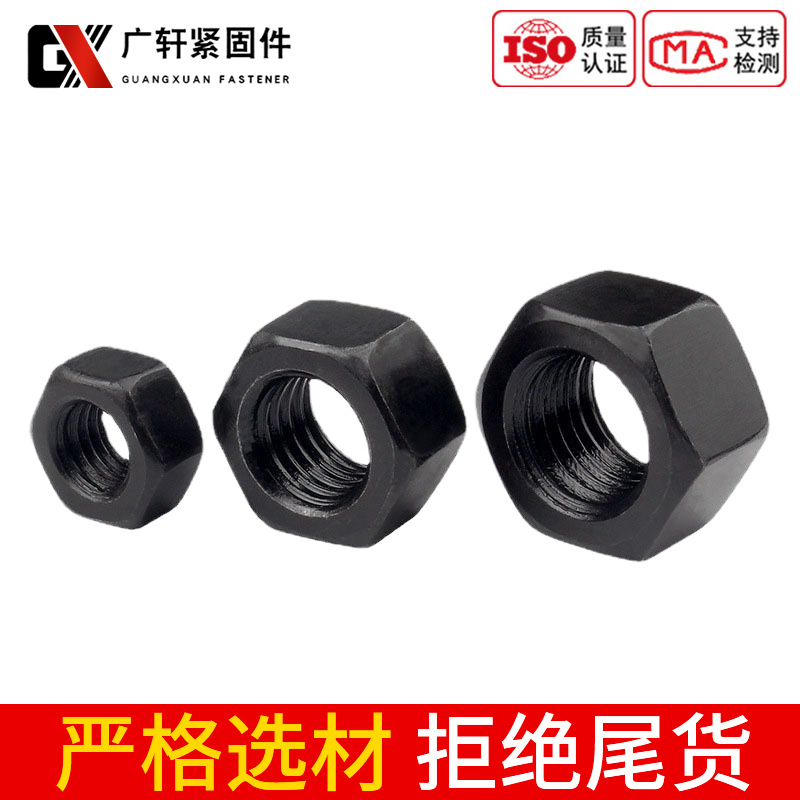
FAQ: Technical Selection Guide for Oxidation Blackening Thickened Locking Nuts
Q1: How to select the thickness of the oxidation black film layer?
A: The film thickness needs to balance corrosion resistance and adhesion. It is usually recommended to control it between 8-12μm: when the thickness is less than 8μm, the salt spray test may be less than 72 hours; when the thickness is more than 12μm, the film is prone to脆化and detachment. Guangxuan fasteners can achieve 96 hours of salt spray without rusting at a thickness of 10μm through the low-temperature composite blackening technology, considering both performance and cost.
Q2: How to control deformation of thickened cap nuts after heat treatment?
A: Heat treatment deformation mainly originates from uneven temperature and differences in cooling rates. Guangxuan utilizes a vacuum quenching furnace (temperature uniformity ±3℃) and step quenching process (first oil-cooled at 650℃, then tempered at 200℃), controlling the deformation to less than 0.3%, a 60% reduction compared to traditional salt bath quenching deformation.
Q3: How to solve the insufficient precision of the locking structure?
A: The fluctuation of clamping force is often caused by the unsynchronized processing of threads and clamping slots. Guangxuan introduces CNC synchronous processing technology, completing thread rolling (accuracy ±0.02mm) and laser clamping slot processing (depth accuracy ±0.01mm) in one clamping, reducing the fluctuation range of clamping force to ±5kN, meeting the requirements of high-intensity assembly.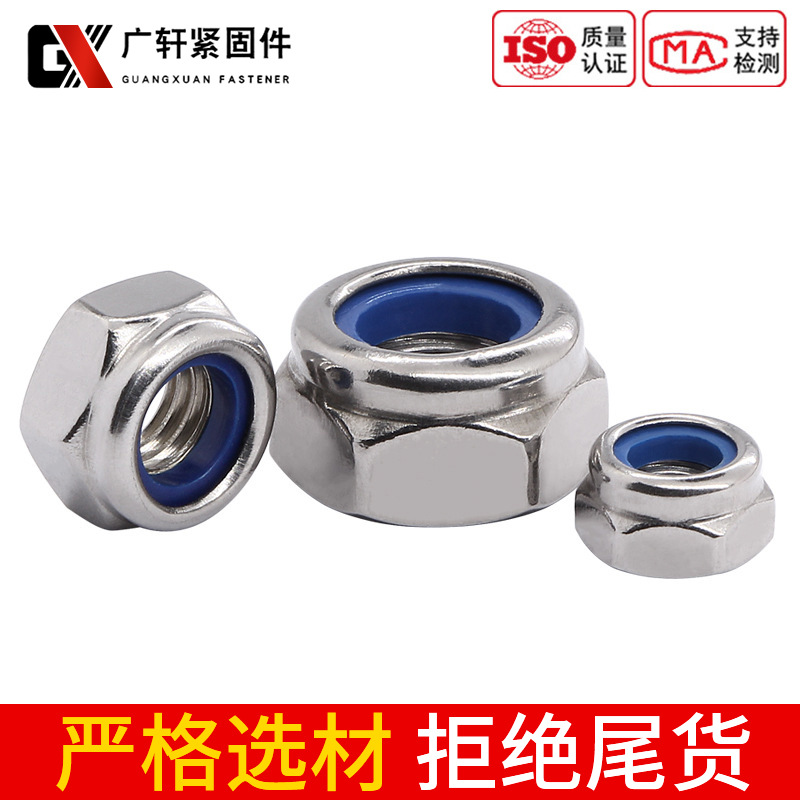
Summary: Technology-driven, Quality-pioneering
The production of thickened locking nuts with blackening and oxidation requires overcoming three major challenges: process stability, processing accuracy, and quality control. Handan Guangxuan Fastener Manufacturing Co., Ltd. has improved the product pass rate from 75% to 92% through low-temperature composite blackening technology, multi-station cold heading forming control, and CNC synchronous processing solutions. Core indicators such as salt spray testing and clamping force all exceed industry standards. The company adheres to the principle of "reliable quality and customer-oriented," implementing 12 quality inspection procedures (such as spectral analysis, hardness testing, salt spray testing) from raw material entry to finished product shipment to ensure that every product meets national standards such as GB/T 5782-2016. Choosing Guangxuan means choosing dual protection of technical strength and quality assurance.