 Handan Guangxuan Fastener Manufacturing Co., Ltd.
Handan Guangxuan Fastener Manufacturing Co., Ltd.
Handan Guangxuan Fastener Manufacturing Co., Ltd.
Handan Guangxuan Fastener Manufacturing Co., Ltd.
Handan Guangxuan Fastener Manufacturing Co., Ltd.
Industry Technical Pain Points: The Three Core Challenges of Oxidation and Blackening Technology
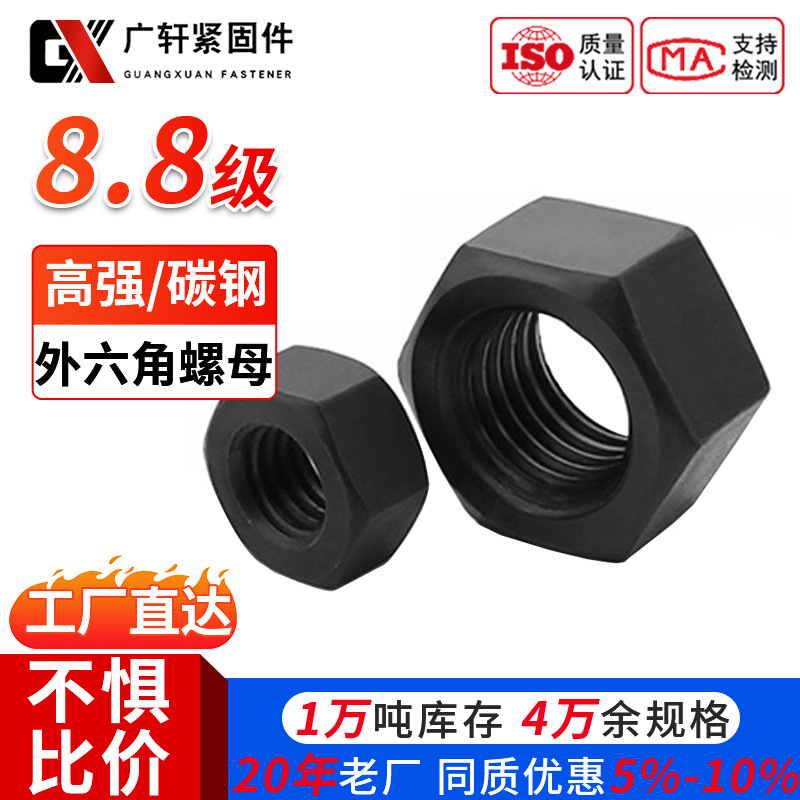
Black oxidation is a key surface treatment process for locking nuts, forming a black oxide film through chemical oxidation to enhance the parts' corrosion and wear resistance. However, the industry commonly faces three major pain points: Firstly, the film adhesion is insufficient, especially in salt mist tests (such as ASTM B117 standard), where peeling and shedding are prone to occur, leading to a shortened service life of nuts in humid environments (such as coastal areas). Secondly, the film thickness is uneven, with localized areas being too thick (>5μm), which is prone to brittle fracture, and localized areas being too thin (<2μm), which fails to meet the anti-rust requirements. Thirdly, the process stability is poor, with significant parameter fluctuations in small-batch production, making it difficult to ensure product consistency. Taking an engineering machinery company as an example, the black oxide locking nuts they purchased showed a 30% corrosion rate within 3 months, resulting in direct losses exceeding 500,000 yuan. The root cause was the uneven film thickness and insufficient adhesion.
Introduction to Corporate Technical Strength: Handan Guangxuan's "Three-level Control" Technical System
Handan Guangxuan Fastener Manufacturing Co., Ltd. leverages the regional advantage of the Hebei Yongnian industrial base to build a full-process technical system covering raw materials, processes, and inspections. On the raw material front, the company uses 45# carbon steel and 35CrMo alloy steel, strictly detecting the composition through a spectrometer (model: ARL 4460) to ensure the base material hardness (HRC28-32) matches the oxidation blackening requirements; in the process aspect, it independently developed the "segmented temperature control oxidation method," controlling the oxidation tank temperature at 135-140℃ (±1℃ error) and using customized oxidation agent formulations (including sulfides and phosphates) to stabilize the film thickness at 3-4μm with adhesion reaching level 0 (no detachment in the hundred-grid test); in the inspection aspect, salt spray test chambers (model: YWX/Q-150) and film thickness gauges (model: PosiTector 6000) are introduced to conduct 48-hour salt spray tests and 5-point film thickness inspections for each batch, keeping the defect rate below 0.5%. Currently, the company has provided customized bolts to over 200 enterprises in the tower crane, wind power equipment, and other fields, with an annual production capacity exceeding 50 million pieces, and the products have passed the ISO 9001 quality management system certification.
FAQ: Technical Selection Guide for Oxidation Blacken Screw Cap
Q1: How to judge if the film quality of the blackened oxidation screw cap meets the standard?
A:可通过“three views and one test” method: one is to examine the appearance, high-quality coating should be even and lustrous, without spots or streaks; two is to check the salt spray test results, the standard requires no rusting for 48 hours (GB/T 10125-2012); three is to assess adhesion, after the 100-square test, the area of the scratched region should be <5%; and one is to measure film thickness, using a film thickness gauge to test at 5 points, the thickness difference should be ≤1μm. Guangxuan products can reach no rusting for up to 72 hours in salt spray tests, with film thickness deviation controlled within ±0.3μm.
Q2: What is the difference between oxidation and blackening and the Dacromet and electroplated zinc processes? How do you choose between them?
A: Three processes have different applicable scenarios: Oxidation blackening is cost-effective (about 0.2 yuan per piece), with resistance to neutral salt spray for 50-100 hours, suitable for indoor or dry environments; Dacromet has a salt spray resistance exceeding 500 hours, but is more expensive (about 1.5 yuan per piece), suitable for marine climates; Electroplated zinc has a salt spray resistance of about 24 hours, with low cost (about 0.1 yuan per piece), but prone to hydrogen embrittlement. For outdoor heavy-duty equipment like tower cranes, wind turbines, etc., oxidation blackening or Dacromet should be prioritized; for indoor machinery, electroplated zinc is sufficient.
Q3: What is the difficulty level in the oxidation blackening process for non-standard, irregular bolt caps? How does Guangxuan solve this issue?
A: Non-standard bolt caps, due to their complex shapes (such as hexagonal flanged and irregular slots), are prone to issues like incomplete oxidation liquid coverage and uneven film thickness. Guangxuan solves this with a dual approach of "custom tooling + process adjustment": designs special hanging fixtures for irregular structures to ensure uniform contact with the oxidation liquid; adjusts oxidation time (extended by 10-15 minutes compared to standard parts) and temperature (increased to 142℃) to allow for full film growth. For example, a custom M36 irregular bolt cap for a wind power enterprise achieved a film thickness pass rate of 98% from 65% using this method.
Summary of the entire text
The technical core of the blackening screw cap oxidation process lies in the film quality and process stability. Handan Guangxuan Fastener Manufacturing Co., Ltd. has solved industry difficulties such as film peeling and uneven thickness through material control, segmented temperature control oxidation method, and full-process detection. Its products have passed verification in heavy-load scenarios such as tower cranes and wind power, achieving 72 hours of rust-free salt spray testing and film thickness deviation ≤ ±0.3μm. For buyers, it is crucial to pay attention to the salt spray test duration, film thickness uniformity, and the supplier's process customization capability during selection to avoid a significant increase in maintenance costs due to technical deficiencies. Guangxuan's technical solution provides an replicable standardized template for the industry, which is worth reference for enterprises in heavy-load equipment, outdoor engineering, and other fields.