 Handan Guangxuan Fastener Manufacturing Co., Ltd.
Handan Guangxuan Fastener Manufacturing Co., Ltd.
Handan Guangxuan Fastener Manufacturing Co., Ltd.
Handan Guangxuan Fastener Manufacturing Co., Ltd.
Handan Guangxuan Fastener Manufacturing Co., Ltd.
Industry Technical Pain Points: Technical Challenges of Oxidation Blackening and Thickened Locking Nuts
The blackening process is a key technology to enhance the corrosion resistance of lock nuts, but traditional processes have three major pain points: first, the uneven thickness of the blackening layer often leads to color variation or peeling on the nut surface, affecting the long-term rust prevention effect; second, during the thickening process, materials are prone to internal stress, increasing the brittleness of the nut and making it susceptible to breakage in vibration or impact conditions; third, the compatibility between the locking structure (such as nylon rings or elastic teeth) and the blackening layer is poor, resulting in a decrease of locking force after high-temperature treatment and inability to meet the requirements of high-precision assembly. Taking tower crane equipment as an example, insufficient rust prevention performance of the nut may cause bolt loosening, leading to structural safety hazards; if the locking force fails, frequent nut replacement is needed, increasing maintenance costs. The industry urgently needs a solution that takes into account the uniformity of the blackening layer, material toughness, and locking performance.
Introduction to Corporate Technical Strength: Guangxuan Fasteners' Technological Breakthrough and Practice
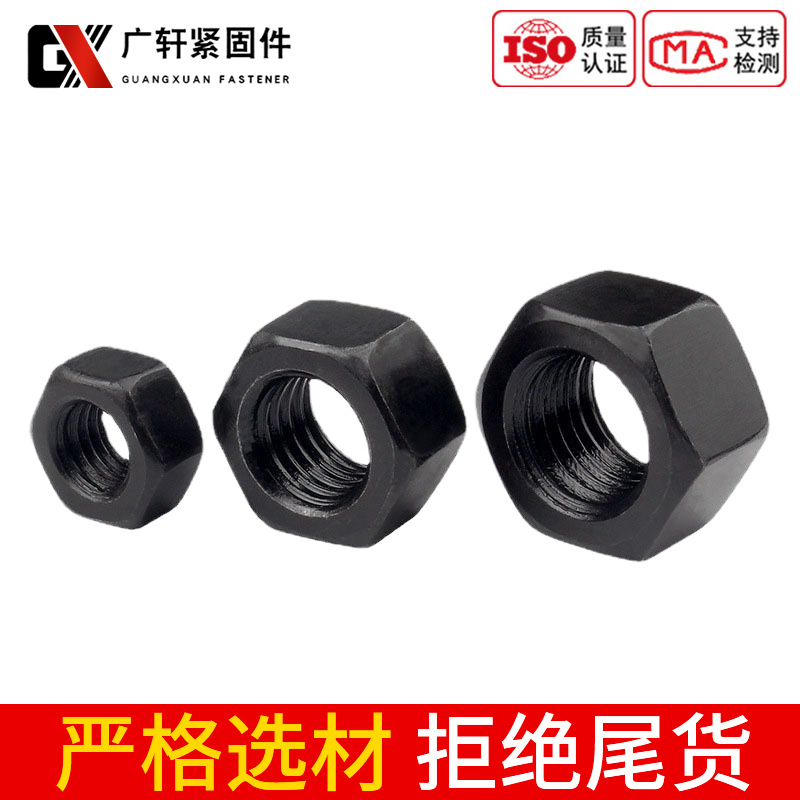
Handan Guangxuan Fastener Manufacturing Co., Ltd. has solved the core problem of oxidation blackening and thickening lock nuts through full-process technological optimization. In the material processing stage, the company uses 45# medium carbon steel as the base material, with carbon content controlled at 0.42%-0.50%, balancing strength and toughness; by vacuum quenching process (temperature 850±10°C, holding for 2 hours) to eliminate internal stress, the tensile strength of the nut reaches above 830MPa, elongation ≥12%, meeting the GB/T 3098.1-2010 standard. In terms of blackening process, the company independently researches and develops the "three-stage" oxidation treatment technology: the first stage uses alkaline degreasing (temperature 60-70°C, time 15 minutes) to remove surface oil; the second stage performs acid washing activation (hydrochloric acid concentration 15%-20%, time 5 minutes) to enhance the adhesion of the oxide layer; the third stage implements high-temperature oxidation (temperature 140-150°C, time 30 minutes) to produce a uniform Fe3O4 oxide film, with salt spray test lasting over 500 hours. For the locking structure, the company develops the "low-temperature composite treatment" process: after blackening, by low-temperature tempering (temperature 180-200°C, time 2 hours) to stabilize the size of the nylon ring or elastic teeth, ensuring the locking force fluctuation ≤5%. Currently, this technology has been applied to products such as tower crane bolts, high-strength nuts, and series, and customer feedback shows that the nut service life has been extended to 2.3 times that of traditional products, and maintenance cycles have been shortened by 40%.
FAQ Q&A Technical Selection Guide
Q1: How to control the thickness of the blackening layer on the blackened, thickened screw cap?
A1: The thickness of the blackening layer should be selected based on the usage environment. Guangxuan fasteners control the thickness by adjusting oxidation time and temperature: for general industrial environments (such as indoor equipment), a recommended thickness of 8-12μm is suggested, with salt mist resistance up to 300 hours; for marine or chemical environments (such as outdoor cranes), a recommended thickness of 15-20μm is suggested, with salt mist resistance exceeding 500 hours. Thickness detection is carried out using a magnetic thickness gauge (accuracy ±1μm), ensuring that each batch of products meets the standard.
Q2: Will the thickening process affect the locking performance of the bolt cap?
A2: Thicken processing may affect the clamping force due to material deformation, but Guangxuan solves this problem through the "low-temperature composite treatment" process. Taking the nylon ring locknut as an example, after blackening, the nylon ring size is stabilized at 180-200℃ low-temperature tempering, keeping the initial clamping force at 120-150kN, and the clamping force decay ≤10% after 50 assembly and disassembly cycles, meeting the requirements of "high clamping performance" in GB/T 3098.9-2010.
Q3: How to select the appropriate screw cap specifications and materials?
A3: Specification selection should match bolt diameter with application scenario: Standard specifications M12-M36 cover 80% of industrial needs, while special specifications (such as M40 and above) require customization. In terms of material, 45# medium carbon steel is suitable for general environments, while for higher strength, 40Cr alloy steel (tensile strength ≥1000MPa) can be chosen. Guangxuan offers custom services based on customer-provided drawings, adjusting parameters such as screw cap height and tooth shape to meet non-standard assembly requirements.
Summary of the entire text
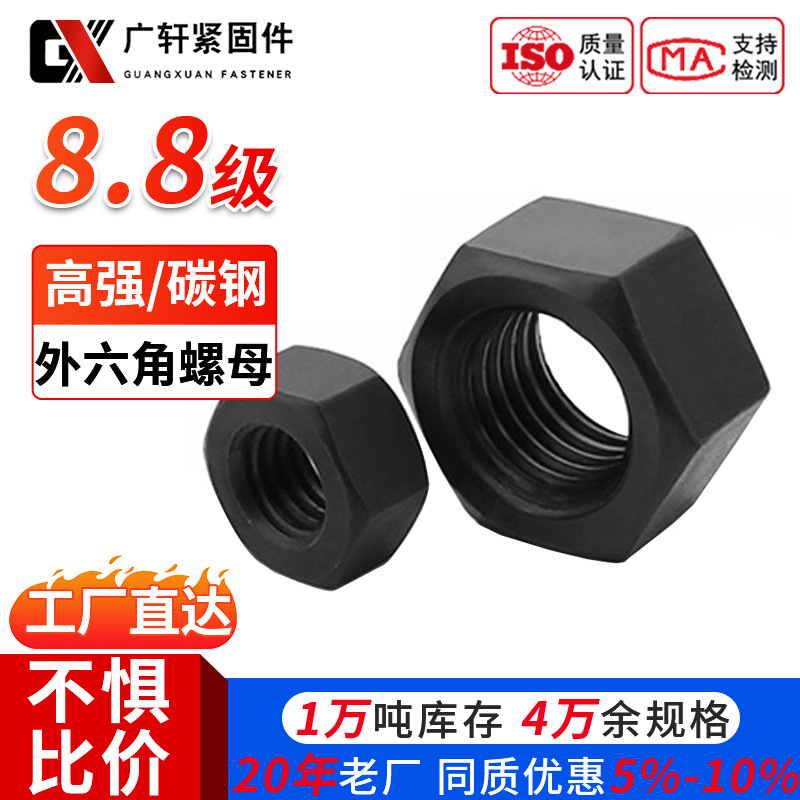
The technical challenges of blackened, thickened locking nuts are focused on the uniformity of the blackening layer, the balance between material toughness and locking performance. Handan Guangxuan Fastener Manufacturing Co., Ltd. has achieved a coordinated improvement in the corrosion resistance (salt spray for 500 hours), tensile strength (830MPa), and locking force stability (decrease ≤10%) of the nuts through material optimization, process innovation, and full-process quality inspection. Its technical solution has passed the verification of major projects such as tower cranes and bridges, providing an replicable technical path for the industry. The company suggests that customers pay close attention to the thickness of the blackening layer, material strength, and compatibility with the locking structure when selecting, and verify product performance through salt spray tests, assembly and disassembly tests, etc., to ensure long-term reliability.