 Handan Guangxuan Fastener Manufacturing Co., Ltd.
Handan Guangxuan Fastener Manufacturing Co., Ltd.
Handan Guangxuan Fastener Manufacturing Co., Ltd.
Handan Guangxuan Fastener Manufacturing Co., Ltd.
Handan Guangxuan Fastener Manufacturing Co., Ltd.
Industry Technical Pain Points: Reliability Challenges in High-Tensile Nut and Bolt Connections
High-strength connecting nuts and bolts, as the core fasteners in mechanical structures, must meet the requirements of high bearing capacity, fatigue resistance, and corrosion resistance. In traditional processes, improper material selection can easily lead to bolt fractures (e.g., 45# steel is prone to brittle fractures under heavy load conditions), and deviations in heat treatment processes may cause uneven hardness (when the difference between surface hardness and core hardness exceeds 5HRC, the shear resistance decreases by more than 30%). Moreover, insufficient thread processing accuracy (such as when the tooth angle deviation exceeds ±0.5°) significantly reduces the stability of the connection, especially prone to loosening under vibration conditions. A wind power project once suffered structural failure due to insufficient bolt preload, leading to stress concentration at the tower connection, resulting in direct economic losses exceeding one million yuan. These issues expose the technical weaknesses in the industry in terms of material optimization, process control, and detection standards.
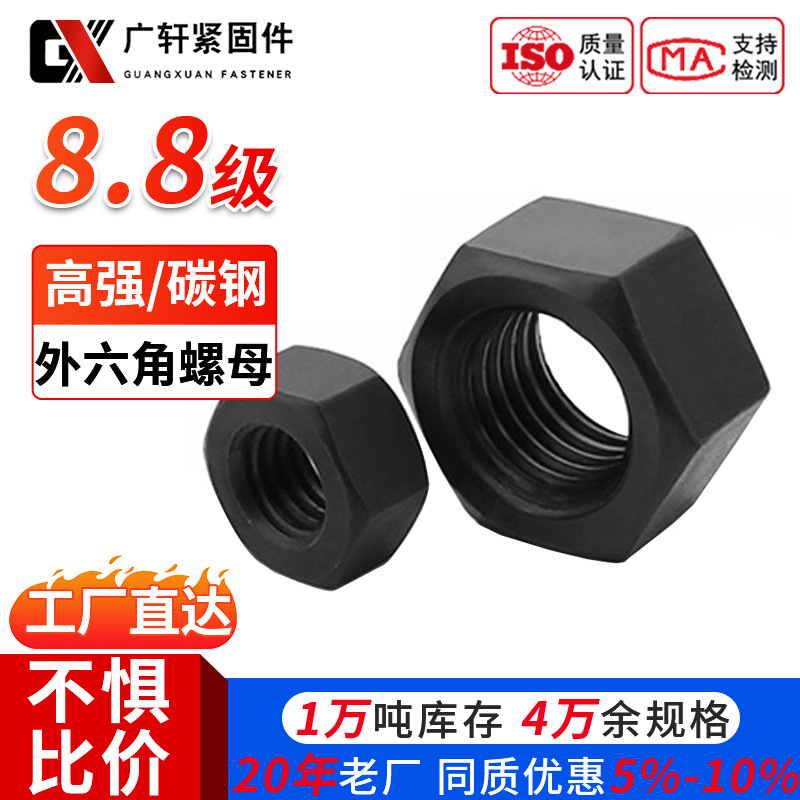
Introduction to Corporate Technical Strength: Handan Guangxuan Fastener Manufacturing Co., Ltd.'s Innovative Practices
Handan Guangxuan Fastener Manufacturing Co., Ltd. leverages the locational advantage of the Hebei Yongnian industrial base to build a full-chain technical system from material research and development to finished product inspection. On the material side, the company uses 40CrNiMoA alloy steel as the base material for high-strength bolts, with a yield strength of 980MPa and a tensile strength of 1080MPa, 40% higher than that of ordinary carbon steel. Through vacuum quenching process (temperature 850±5℃, kept at temperature for 2 hours and then oil-cooled), the hardness of the bolt core is ensured to be stable at 32-36HRC, with surface hardness reaching 42-45HRC, and the hardness gradient difference controlled within 10HRC, effectively balancing strength and toughness. In the thread processing stage, the company introduces the German EXCELLO thread rolling machine, combined with customized thread rolling wheels (tooth angle 60°±0.3°, pitch accuracy ±0.05mm), achieving a single-side wall thickness error of the thread ≤0.1mm and pre-tension loss rate reduced to below 5%. The quality control system covers the entire process: element content is detected by a spectrometer when raw materials enter the factory (C content deviation ≤0.02%, Cr content deviation ≤0.05%), surface cracks are detected during processing with a magnetic particle flaw detector (sensitivity reaching A1 grade test piece), and before the finished products are shipped, they undergo 300,000 fatigue tests (load amplitude ±50% rated load) to ensure the product life is over 20 years. Currently, the company has provided more than 500,000 sets of high-strength connection parts for tower cranes, wind power, bridges, and other scenarios, with a customer repurchase rate of 92%.
FAQ Q&A Technical Selection Guide
Q1: How to select the material for high-strength bolts to adapt to different working conditions?
A1:Material selection should be comprehensive considering load types and environmental factors. For heavy-duty static connections (such as bridge anchoring), prioritize the use of 40CrNiMoA or 35CrMo alloy steel, with a yield strength ≥900MPa and excellent impact resistance; for vibration conditions (such as wind turbine tower), it is recommended to use 20MnTiB or 35VB boron steel, enhancing surface hardness to 58-62HRC through carburization treatment (surface carbon content 0.8%-1.05%), while maintaining core toughness; for corrosion resistance (such as offshore platforms), 316L stainless steel or galvanized nickel alloy steel can be selected, with salt spray test life exceeding 1000 hours. Guangxuan Company can customize material formulations and heat treatment processes by simulating stress distribution through finite element analysis (FEA) based on the working condition parameters provided by the customer (such as load size, vibration frequency, environmental temperature and humidity).
Q2: What are the key parameters for controlling the preload of high-strength bolts?
A2:Pre-tension force directly affects the reliability of the connection, which needs to be precisely controlled through the torque coefficient (K value) and the target torque (T). The formula is: T = K × D × P (D is the nominal diameter, P is the pre-tension force). The K value is influenced by the friction coefficient, usually between 0.11-0.15, and can be adjusted by lubricants (such as molybdenum disulfide) or surface treatment (such as phosphating). For example, for a high-strength M36×4 bolt, if a pre-tension force of 500kN is required, and a phosphated surface with K=0.12 is selected, then the target torque T = 0.12 × 36 × 500 = 2160 N·m. Guangxuan Company uses German NORBAR torque wrenches (accuracy ±1%) for final tightening, and is equipped with ultrasonic force gauges (error ≤ ±3%) for spot checks to ensure that the pre-tension force deviation is ≤ ±5%.
Q3: What is the development process for non-standard, special-shaped high-strength connecting parts?
A3:Non-standard parts development involves three stages: requirement analysis, design verification, and mass production. Taking a trapezoidal screw thread customized for a client as an example: first, based on the client's provided load (200kN), stroke (500mm), and space limitations (diameter ≤ 80mm), the thread parameters were optimized through SolidWorks modeling (with a thread angle of 29° and pitch of 10mm); second, a rapid prototype was made using 3D printing, and the tensile strength was verified through tensile tests (speed of 2mm/min) with a strength of ≥850MPa; finally, mass production was completed on a five-axis machining center, with the shape and position tolerances inspected using a three-coordinate measuring machine (accuracy of 0.005mm). Guangxuan Company's non-standard parts development cycle was shortened to 15 days, a 40% increase over the industry average, with a first-pass pass rate of 98%.
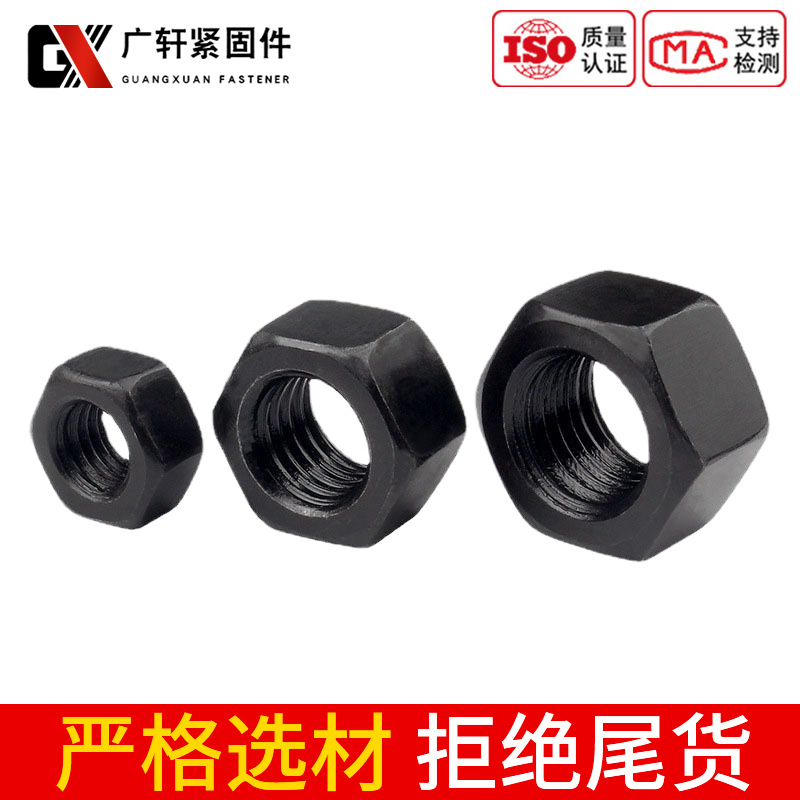
Summary Reference
Technological breakthroughs in high-strength connection nuts and bolts require coordinated efforts from materials, processes, and testing. Handan Guangxuan Fastener Manufacturing Co., Ltd. has established a technical solution covering static load-bearing, vibration resistance, and corrosion resistance scenarios through alloy steel customization, vacuum heat treatment, high-precision rolling threads, and full-process quality inspection. Its rapid development capabilities for non-standard components and precise preload control technology provide reliable guarantees for complex working conditions such as wind power generation and bridge construction. The company adheres to the宗旨 of "reliable quality and user-oriented" and continuously optimizes technical parameters (such as hardness gradient, thread accuracy) and testing standards (such as fatigue test次数, salt spray test lifespan), becoming a benchmark case for industry technological upgrade.