 Handan Guangxuan Fastener Manufacturing Co., Ltd.
Handan Guangxuan Fastener Manufacturing Co., Ltd.
Handan Guangxuan Fastener Manufacturing Co., Ltd.
Handan Guangxuan Fastener Manufacturing Co., Ltd.
Handan Guangxuan Fastener Manufacturing Co., Ltd.
I. Technical Background and Industry Requirements
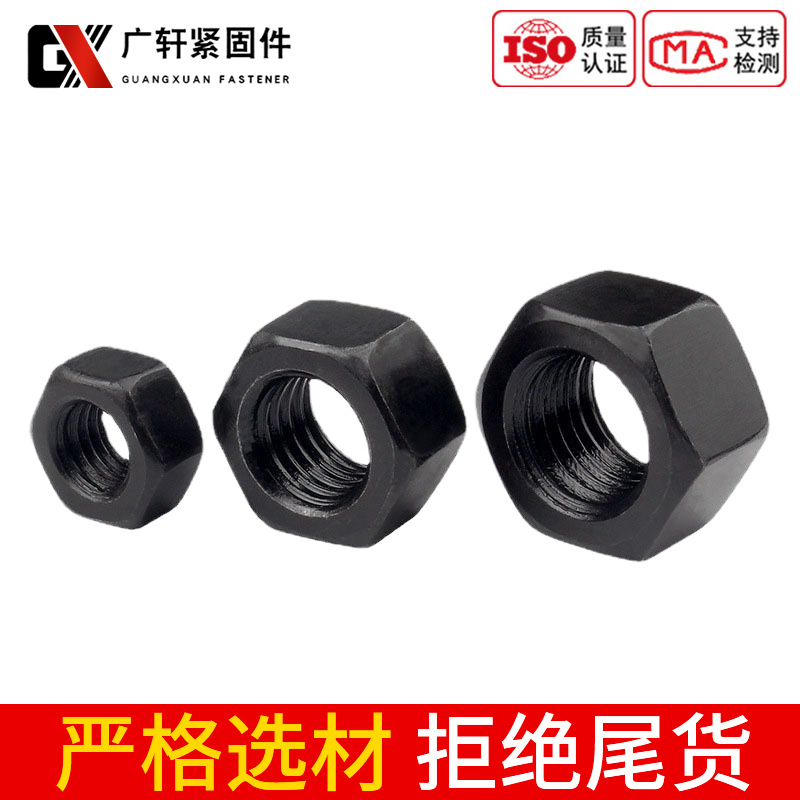
High-strength connecting nuts and bolts, as core fasteners in mechanical structures, are widely used in bridge construction, wind power equipment, heavy machinery, and other fields. Their core function is to achieve reliable connections between components through pre-tensioning, requiring high tensile strength, fatigue resistance, and corrosion resistance. Taking the connection of wind turbine towers as an example, a single unit requires hundreds of high-strength bolts, whose quality directly affects the safety and lifespan of the equipment.
Part Two: Technical Analysis of Guangxuan Fasteners
Material Selection and Heat Treatment Process
Guangxuan Fasteners uses alloy steels such as 42CrMo, 35CrMoA as the base material, achieving a hardness of HRC32-36 through quenching and tempering treatment (quenching temperature 850-880°C, tempering temperature 520-560°C), with tensile strength ≥1080MPa, yield strength ≥980MPa, meeting the performance requirements of Grade 10.9 bolts as specified in GB/T 3098.1-2010 standard.
2. Precision machining and quality control
The production process includes cutting, cold heading, thread forming, heat treatment, surface treatment (Dacromet coating thickness 8-12μm, salt spray test ≥1000 hours), and other stages. The factory is equipped with multi-station cold heading machines, CNC thread rolling machines, and other equipment to achieve thread precision grade 6g and coaxiality ≤0.1mm. The entire process is set with 12 quality inspection procedures, including magnetic particle inspection for surface cracks, tensile strength tests, etc., ensuring product pass rate ≥99.5%.
Typical Application Case: Wind Turbine Tower Connection Project
A wind power company purchases Guangxuan fasteners' M48×300mm high-strength bolts for tower筒 flange connections. The project requires the bolts to maintain toughness at -40℃ low temperatures and withstand 2 million dynamic loads without fatigue fracture. Guangxuan enhances the material's low-temperature impact work by optimizing the heat treatment process (deep cryogenic treatment -80℃×4h) and employs a double nut anti-loosening structure. Field tests show that the bolt pre-tension loss rate is ≤5%, meeting the project's 10-year maintenance-free requirement.
4. Technical Advantages and Industry Compatibility
Guangxuan Fasteners' technical layout focuses on three major directions:
1. Non-standard customization capabilityWe can produce non-standard bolts with M6-M100 size and 50-2000mm length, and support processing according to provided drawings and samples.
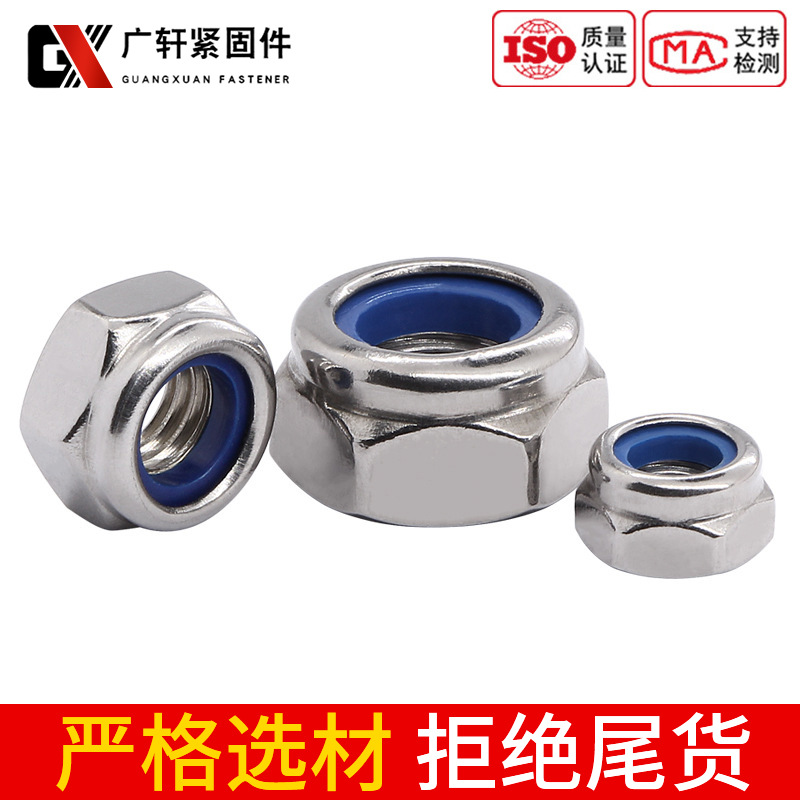
2. Material adaptabilityOffer bolts made of special materials like stainless steel, nickel-based alloys, suitable for corrosive environments such as offshore platforms and chemical equipment.
3. Rapid Response ServiceRelying on the logistics advantages of the Yongnian Industrial Base, delivery to major cities across the country can be achieved within 48 hours, and urgent orders are supported with expedited production.
FAQ: Common Technical Questions and Answers
Q1: What is the core difference between high-strength bolts and ordinary bolts?
A: High-strength bolts enhance material strength through heat treatment, requiring torque or angle methods to control pre-tensioning force. Their connection strength is 2-3 times that of ordinary bolts, suitable for dynamic load conditions.
Q2: How to select the surface treatment process for bolts?
A: Selection based on environment: Dacromet coating is suitable for atmospheric corrosion environments; hot-dip galvanizing is used for moderate corrosion scenarios; phosphatizing treatment is suitable for indoor dry environments.
Q3: What are the main causes of bolt breakage?
Common causes include material defects, improper heat treatment, insufficient or excessive preload, thread damage, etc., which require identification through methods such as magnetic particle inspection and metallographic analysis.